
Personalized nutrition designed for your unique health goals.
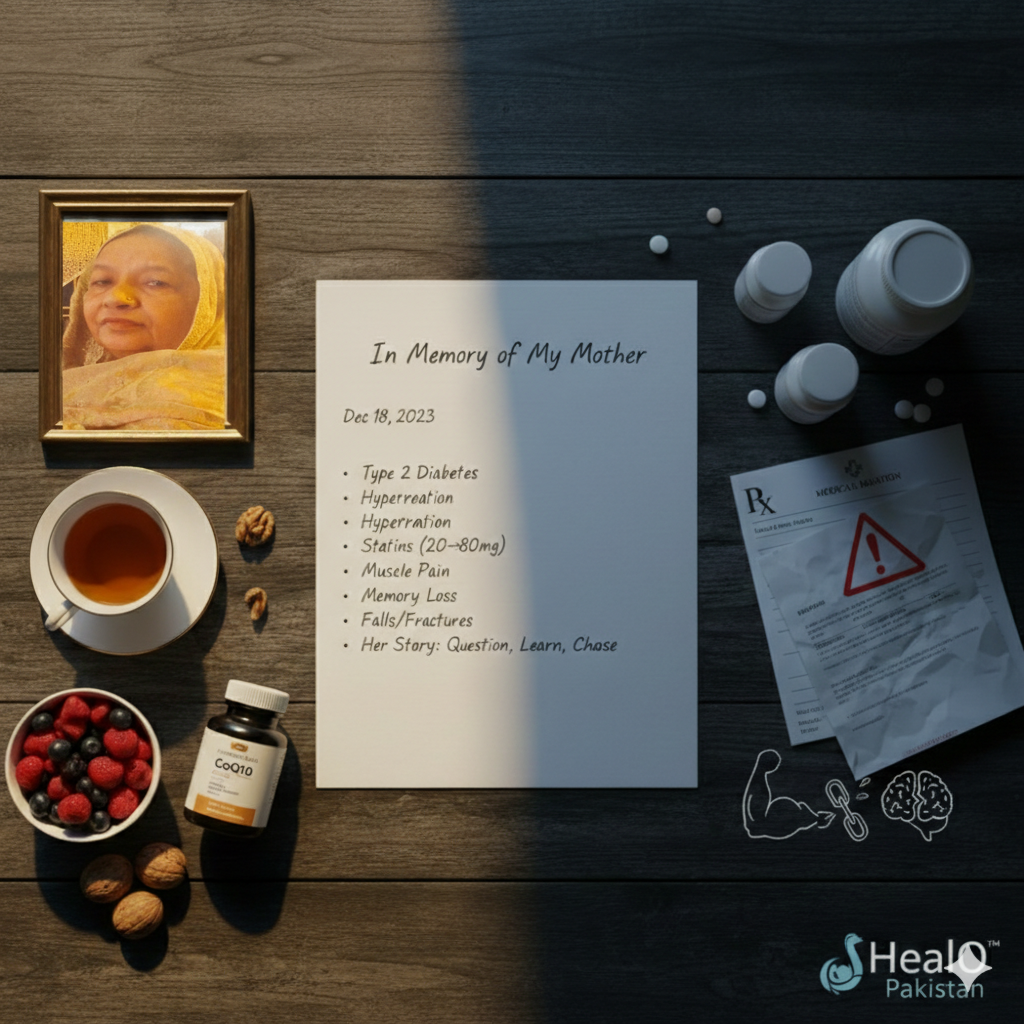
On December 18, 2023, my beloved mother returned to her Creator. This post is written in her memory, as sadaqa e jariya, with the hope that her story may help others question, learn, and make informed choices about their health.
🌸 My Mother’s Journey
- Eldest of seven, married young, and burdened with responsibilities from her teenage years.
- Diagnosed with type 2 diabetes and hypertension in her early life, managed with Glucophage and Aldomet for decades.
- Later shifted to insulin and multiple blood pressure medications.
- In 2011, after backbone surgery, her cholesterol was found high, and she was prescribed statins—starting at 20 mg, eventually reaching 80 mg daily.
Over the years, she suffered muscle pain, weakness, memory loss, falls, fractures, and anxiety. Despite these symptoms, doctors continued prescribing statins. At times, when she stopped them and focused on diet and exercise, her strength and sleep improved. But each return to statins brought deterioration.
⚕️ What Are Statins?
Statins are drugs that inhibit HMG-CoA reductase, blocking the mevalonate pathway—the process by which cells produce cholesterol and vital compounds called isoprenoids.
- Cholesterol lowering: Statins increase LDL receptors in the liver, pulling cholesterol from the blood.
- Hidden cost: Blocking mevalonate also blocks isoprenoids and CoQ10, essential for cell energy, muscle function, and nerve repair.
- Result: Cells starve, mitochondria weaken, and side effects emerge—muscle pain, neuropathy, fatigue, and more.
Doctors celebrate “good numbers” on lab reports, but the underlying cellular damage often goes unnoticed.
⚠️ The Side Effects Nobody Talks About
Research and patient experiences show statins may contribute to:
- Muscle pain, weakness, and rhabdomyolysis (severe muscle breakdown).
- Increased risk of type 2 diabetes.
- Cognitive decline, memory loss, and neuropathy due to impaired myelin repair.
- Heart failure from CoQ10 depletion.
- Vascular calcification when combined with blood thinners like warfarin or aspirin.
These are not “rare side effects”—they are predictable consequences of blocking a fundamental metabolic pathway.
🧠 Cholesterol: Friend, Not Foe
Contrary to popular belief:
- Cholesterol is vital for brain health, myelin repair, hormone production, and immunity.
- Studies show older adults with higher cholesterol live longer.
- Low cholesterol is linked to higher mortality from stroke, heart disease, and cancer.
My mother’s health improved when her cholesterol rose—she regained mobility, strength, and sleep. Yet doctors insisted on lowering it again, with devastating consequences.
❓ The Questions We Must Ask
- Why did her health improve when cholesterol went up?
- Why did mobility return when she stopped statins?
- Why do mainstream guidelines ignore the protective role of cholesterol?
- Why are lifestyle changes—diet, exercise, reducing sugar and seed oils—not emphasized over drugs?
🌿 A Better Way Forward
Preventing cardiovascular disease is not about chasing cholesterol numbers. It’s about:
- Lowering blood glucose and inflammation.
- Avoiding processed carbs and seed oils.
- Improving triglyceride-to-HDL ratio.
- Supporting mitochondrial health with nutrient-rich foods.
✨ Final Reflection
My mother did not die because she ignored medical advice. She died because she followed it faithfully. Her story is a reminder that patients deserve informed consent—to know both the benefits and risks of medications, and to be offered lifestyle-based alternatives.
Statins are not harmless “cholesterol pills.” They are powerful metabolic disruptors. Before accepting them, think carefully about the gamble you’re taking.
🔗 Suggested Reading
- Mechanism of statin-induced muscle dysfunction (PubMed) (pubmed.ncbi.nlm.nih.gov in Bing)
- Statins and diabetes risk (NMCD Journal) (nmcd-journal.com in Bing)
- Statins and neurodegeneration (PubMed) (pubmed.ncbi.nlm.nih.gov in Bing)
- Higher cholesterol linked to longer life (Rogue Health & Fitness) (roguehealthandfitness.com in Bing)
- Recent Post