
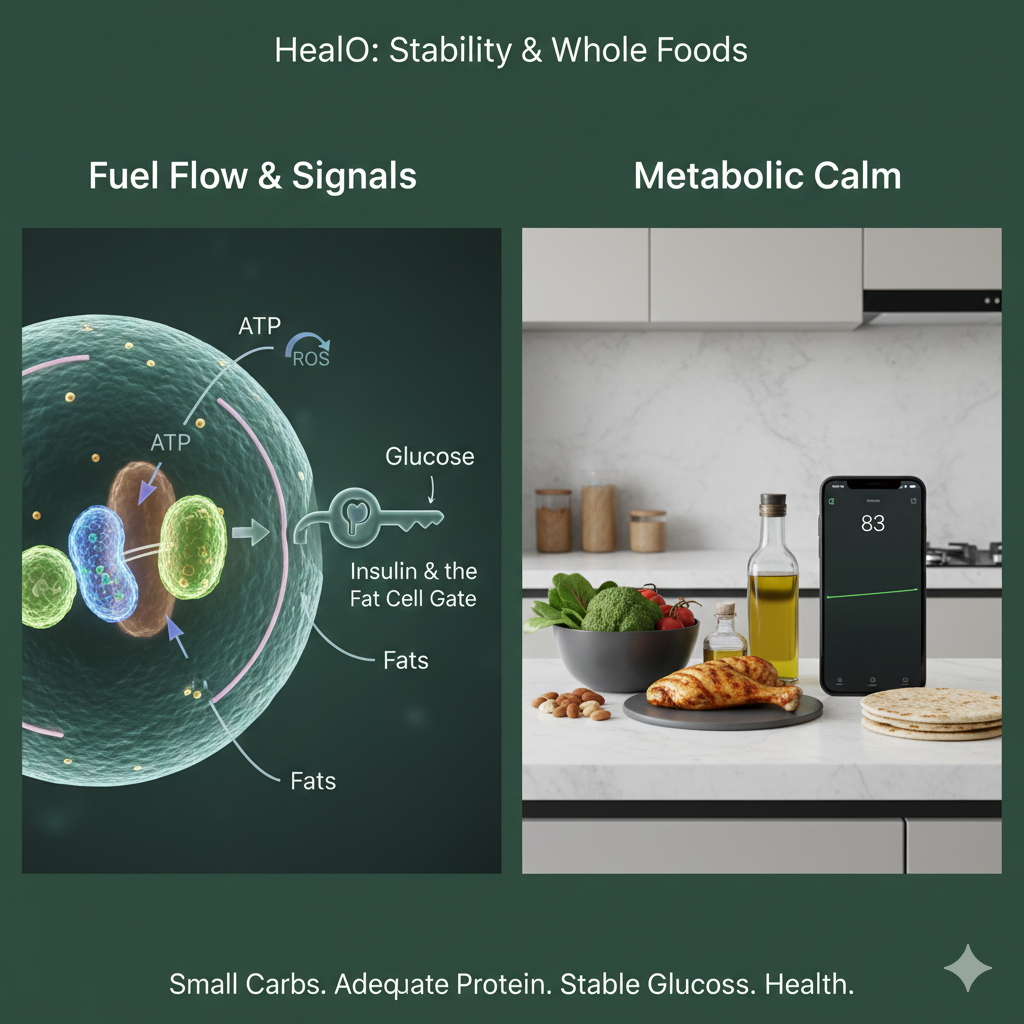
Insulin’s core job is fuel management. After you eat, it helps move glucose into cells and signals fat cells to store excess energy. When fat cells are responsive (insulin-sensitive), they take in fuel efficiently. As they fill, they can become relatively resistant to further insulin signaling — a local protective mechanism to prevent unlimited expansion. System-wide insulin resistance, however, is harmful and linked to metabolic disease. The goal isn’t to “fight insulin,” but to reduce chronic overload so the system stays flexible.
🧬 Mitochondria, Fuel Flow & Signals
Inside fat cells, mitochondria process fuels through the electron transport chain to make ATP. Different fuels enter this pathway slightly differently, producing varying amounts of NADH and FADH₂. These shifts can influence cellular redox state and reactive oxygen species (ROS) signaling. ROS aren’t purely “bad”; in controlled amounts they act as signaling molecules. However, obesity is multifactorial — total energy balance, food quality, sleep, activity, genetics, and ultra-processed food exposure all interact. No single molecule explains the epidemic on its own.
🥑 Saturated Fat vs 🌻 PUFA: What We Know (and Don’t)
It’s true that saturated and polyunsaturated fats are metabolized differently at the biochemical level. But the idea that seed oils uniquely “keep fat-cell gates open” while saturated fats reliably “close them” via mitochondrial reverse electron transport is still debated and not established as a primary driver of population-level obesity.
What is well supported:
Excess refined carbohydrate plus excess total calories promotes fat storage.
Ultra-processed food combinations (refined carbs + industrial fats + hyper-palatability) increase passive overconsumption.
Replacing refined carbs with whole foods improves metabolic markers in many people.
Since the 1980s, refined carbohydrate intake, sugar exposure, portion sizes, and food processing all rose substantially. Seed oil use also increased — but correlation alone doesn’t prove causation. The obesity epidemic likely reflects multiple converging changes.
🍽️ Practical Metabolic Strategy (Applicable to Everyone)
Rather than focusing on one fat as hero or villain, metabolic stability improves when you:
• Prioritize whole, minimally processed foods
• Control refined carbohydrate load
• Ensure adequate protein
• Use fats in reasonable amounts from varied sources (e.g., dairy fats, olive oil, nuts, traditional cooking fats)
• Avoid ultra-processed carb-fat combinations
Stable glucose → stable insulin → less chronic storage pressure.
🩺 Type 1 Diabetes Context
For people living with type 1 diabetes, carbohydrate quantity is the dominant variable affecting insulin dose size and glucose variability. Lower carbohydrate meals typically:
• Require smaller boluses
• Reduce post-meal spikes
• Improve predictability
Whether fats come from ghee, olive oil, nuts, or other whole-food sources matters less than controlling total carb load and avoiding large glucose surges. Very high-fat meals can also delay glucose rise, requiring thoughtful insulin timing.
For T1D families in Pakistan (or anywhere), a practical approach might be:
• Keep carbs modest and mostly from non-starchy vegetables
• Pair with protein
• Use traditional cooking fats (ghee, butter, olive oil, coconut oil, avocado oil, tallow etc) in moderation
• Avoid refined flour + sugar + industrial fried combinations (fried in seed oils)
Lower carb load simplifies dosing far more reliably than swapping one oil for another.
💚 HealO Takeaway
Insulin isn’t the enemy. Chronic overload is.
Fat cells respond to total fuel pressure, not one single nutrient villain. The most consistent metabolic lever across populations — especially in type 1 diabetes — is controlling refined carbohydrate exposure and minimizing ultra-processed food combinations.
Small carb inputs.
Adequate protein.
Reasonable fats.
Stable glucose.
That’s metabolic calm — and calm physiology compounds into long-term health.
References
- https://high-fat-nutrition.blogspot.com/
- https://pmc.ncbi.nlm.nih.gov/articles/PMC4038351/
- https://academic.oup.com/edrv/article/23/2/201/2424219
- https://pmc.ncbi.nlm.nih.gov/articles/PMC2811447/
- https://www.sciencedirect.com/science/article/pii/S0753332221001001
- https://www.jci.org/articles/view/10583
- https://academic.oup.com/edrv/article/34/4/463/2354642
- https://www.jci.org/articles/view/77812
- https://pmc.ncbi.nlm.nih.gov/articles/PMC11378142/
- https://www.nature.com/articles/s41392-022-01073-0
- https://www.molbiolcell.org/doi/10.1091/mbc.e15-10-0749
- https://proteinpower.com/nutrition-and-health-in-agriculturalists-and-hunter-gatherers/
- https://youtu.be/pIRurLnQ8oo?si=diqpBib-Jxhdc-1x
- Recent Post